From the pages of the
 |
"Thin Journal" |
a translation of:
SNOW HOUSE
byALEKSEI N. TOLSTOY
From the pages of the|
|
"Thin Journal" |
The wind was blowing, swirling the white snow and piling it up in great mounds alongside every hut.
On every snow mound, children were riding their sleds. The children could slide and skate everywhere--they could fall head over heels on the ice of the river or do somersaults from the haystacks. The only place they couldn't go was the Averyanov hut, which was in the middle of the village.
A huge snow mound was piled up by Averyanov's hut, and some boys from tahe village of Konchanshoye were standing on it, threatening to spit on everyone.
Averyanov's son, Petechka, had it worst of all. The Konchanskoye boys were making threats, but the locals shouted to Petechka, "You're from Konchanskoye. We'll break your bones!" And no one would play with him.
Petechka became bored and started digging himself a burrow in the snowbank, so that he could climb in and sit there by himself. For a long time, Petchka dug straight ahead; then he worked on the sides. He made a ceiling, walls, and a bench. And there he sat himself.
The blue snow glowed all around, glimmered like crystal. It was quiet and comfy. None of the other children had such a house.
Petchka sat there until his mother called him in for dinner. He crawled out and covered the entrance with blocks of snow. After dinner, he lay on the stove under a fur blanket, tugged his grey cat's paw and whispered into the animal's ear:
"I'm gonna tell you something, Vasya. I have a house better than all the rest. You want to live with me?"
But the cat Vasya didn't answer. Meowing for the sake of appearances, he turned around and jumped under the stove to sniff out mice and to whisper with the domovoi ("house spirit"--trans.) under the house.
Learn about the
Domovoi
Tell them
sent you!
(Illustration by
Boris Zabirokhin.)
In the morning, as soon as Petechka crawled into his snow house, he heard snow crunching. Then clumps of snow came flying, and out of the wall stepped a short muzhik with such a red beard that only one of his eyes was visible. The muzhik shook himself, sat next to Petechka and made a face.
Petechka smiled and asked him to do it again.
"I can't," answered the muzhik. "I'm a domovoi, and I don't want to scare you too much."
"All the same, you scared me just now," Petechka answered.
"You don't have to be scared of me. I like children. It's just that your hut right now is crowded with so many people, and the calf, and such a smell that I just can't take it. So I was just sitting in the snow. But your cat, Vaysa, told me that that you had built such a wonderful house.
"What should we play?", Petechka asked.
"I don't know. Actually, I'd like to nap for a little. I'll call my daughter. She'll play with you and I'll snooze."
The domovoi squeezed his nose and let out a whistle. Out of the snow jumped a rosy-cheeked girl in a mouse-skin coat. She had black brows, blue eyes, and a long braid. A sponge was tied to her waist. The girl laughed and shook Petecheka's hand.
The domovoi lay down on the bench, wheezed a little, and said:
"Go on and play, children. Only don't poke me in the side." And he immediately began snoring. The domovoi's daughter spoke in a whisper:
"Let's play pretend."
"Okay," Petechka answered. "But what kind of game is that? It's not scary, is it?"
"Oh, you, Petechka! Pretend, as if you have on a beautiful silk shirt, you're sitting on the stove bench, and there's a pretzel next to you."
"I see it," said Petechka, and he reached for the pretzel.
"You're sitting," continued the domovoi's daughter as she screwed up her eyes, "and I'm sweeping up the hut. The cat, Vasya, is rubbing himself against the stove. It's clean all around, and the sun is shining. And we get ready to go hunting for mushrooms in the forest. We're barefoot on the grass. The rain has just come down and moistened the grass in front of us. Now the sun is poking through. We run to the forest. There are mushrooms all around."
"So many of them," said Petechka, and his mouth dropped open. "Red ones, and over there is a boletus. Can we eat them? They're not poisonous, are they, pretend mushrooms?"
"You can eat them. Now let's roll down the hillside and go swimming. Look, the river water is clear and you can see fish at the bottom."
"Do you have a pin?" asked Petechka. I'd like to catch a gudgeon with a fly."
But just then the domovoi woke up. He thanked Petechka and crawled out of the snow house with his daughter to go eat.
The next day, the domovoi's daughter came again. They imagined all the places they'd never been. And they played that way every day.
But then winter broke. The grey clouds were chased away, and a moist wind blew. The snow began to slip away and subside; black manure appeared in backyards; the rooks returned, circling over the still-bare branches; and the snow house began to melt.
With difficulty, Petechka climbed inside the snow house, all wet. But the domovoi's daughter did not come. Petechka began to snivel and wipe his eyes with his fists. Then the domovoi's daughter looked in through a hole in the wall, spread out her fingers, and said:
"So wet. I can't even touch it. I have no time to play now, Petechka. I have so much to do, my hands are about to fall off. The house is a real mess."
Petechka began to howl. The domovoi's, daughter clapped her hands and said:
"You're a fool, that's what you are. Spring is coming...that's better than any pretend."
"Call the domovoi, tell him to come here."
Petechka started yelling and wouldn't stop. The domovoi suddenly appeared with a wooden shovel and smashed apart the snow house. "All it does is make things wet," he said.
He took Petechka by the hand and led him to the back yard. There the rowan horse was already standing. The domovoi jumped up on the horse, put Petechka in front of himself, and his daughter behind, and slapped the horse with his shovel. The horse took off, galloping along the melting snow up to the forest. In the forest, from under the snow, icy springs were running, green grass was beginning to break through to freedom; thawed leaves were moving; noise was rising from ravines; buds covered the still-bare birch trees; rabbits were running about, scratching off their winter fur and turning joyful somersaults; geese were flying in the blue sky.
The domovoi helped Petechka and his daughter down off the horse, then rode off further by himself. The domovoi's daughter wove a yellow wreath, put her hand to her mouth and shouted:
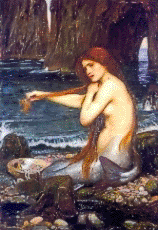
Read A.S. Pushkin's poem:
"Rusalka"
Tell them
sent you!
"Hey, rusalki (water nymphs, mermaids--trans.), mavka sisters (another type of water spirit--trans.)! Enough sleeping!"
Calls of greeting resounded through the forest, and from all sides, like a spring thunder, echoed the rusalki voices.
"Let's run to the mavki,", the domovoi's daughter said. "They'll give you a pretty shirt--a real one, not like the ones we imagined in the snow house."
"We should have brought the cat," said Petechka.
He looked down, and there was the cat, with its tail like a pipe, and mischievous eyes shining.
And the three of them ran into the thick grove to play with the rusalki. But this time it wouldn't be pretend--it would be real games: swinging in the tree branches, laughing, and awaking the sleepy animals--hedgehogs, badgers, and bears--and dancing happily on the river bank under the sun.
THE END
See also: "Azure Cities" by Aleksei Tolstoy, a summary.
|
Biography of Aleksei N. Tolstoy |

| Mini-Summaries | Encyclopedia of Soviet Writers | Soviet Literature Links | the "Thin Journal" | What's New |
|
Subscribe to the SovLit.com Mailing List. Send e-mail with the word SUBSCRIBE in subject field to: sovlit-subscribe@yahoogroups.com |