
Presents a translation of:
A MIDSUMMER DAY'S GAME
by Vladimir Soloukhin
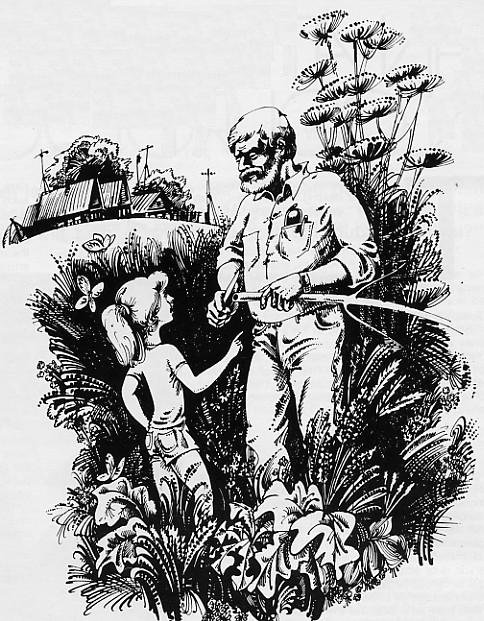
Really, there's not a lot to do in our village for amusement on a hot day in July. You can't go into the woods. "You'd frazzle," as they say in our parts. For the woods, a nice cool overcast day is right. Even fine rain is not a drawback; it has its own charm. At the moment the heat as such is the least of it; there are mosquitoes and horseflies. No, in heat like this, the woods are out. It's hot in the field and the meadow, too, and what's there to go there for anyway? Certainly it's the height of the wildflower season, and you can pick a bunch of flowers. But flowers today, flowers tomorrow ...
So my nine-year-old Natasha was bored. To make things worse, she and her little friends had had a falling out about something. They were in a huff with each other, and they weren't playing together. Natasha was left all alone with the long, long, hot, hot July day.
It wasn't really my job to amuse her, and I needed to spend some more time at my desk, but when you know that there is a nine-year-old city creature fidgeting and fretting somewhere near at hand, it tends to affect your spirits. How could I entertain her?
"Just you wait and see what I'm going to make for you."
"What?"
"A real fine chvikalka."
My little city girl had never heard this word. That didn't matter; it would be all the more interesting for her to watch how and what I would make.
Children and the time we spend playing with them are the only real opportunity an adult human being has to revisit childhood, to take a flight in a magical time machine and go back there, even for half an hour. It would be hard to imagine three adult, middle-aged or elderly people getting together and playing hide-and-seek. Or blindman's buff. Or building toy dams on the stream and then sailing paper boats on the water. But if an adult is with children and showing them, as it were, how it's done, or teaching them various games, he'll jump and run and play like a child himself. Take myself, for example, almost 60 years of age already, sitting at my desk considering my future article on the Bolshoi Theater. It would be odd if suddenly on my own, without little Natasha, I were to start making a chvikalka. Or propose a game of hide-and-seek to my 70-year-old sister. But with Natasha it's not only permissible, it's all perfectly ordinary. If any of our neighbors happens to pass, let them look--Grandpa is sitting making a chvikalka for Natasha, and Natasha is watching with eyes big as saucers.
Meanwhile, I had been overwhelmed by the in-rushing tide of my own childhood. I have a good sharp knife now. In my childhood, I remember, I never had a decent, knife. If by any chance I got hold of something better, somehow it always got lost very quickly. Or it would maybe be pinched by some other envious boy, one of my pals. But now I have just the very knife; how I would have loved one like it when I was a boy! It has a leather sheath and is quite small, but it's a real dagger just the same. You can hang it on your belt. I saw it at the Sunday market in Los Angeles, at the stall of an old Mexican man, and I realized immediately what a pleasure it would be to go gathering mushrooms with a knife like that. The man was asking three dollars, and I didn't grudge the money. So, you see I have a nice sharp knife, and that's a good thing, for every job can be a pleasure instead of a task, but only if you have the right tool in your hands.
Natasha and I set to work with deliberation, relishing every movement. First we went into the garden, our neglected garden, overgrown with various wild plants, to choose the best specimen of the plant we needed. What we needed was a tall, hollow-stemmed angelica.
When we were children, we used to cut it here, too, in the garden or the vegetable patch. But at that time it took refuge beside the fence or in the dense thickets of blackthorn, for the rest of the garden and vegetable patch was properly tended. In one place there were neat rows of vegetables; in another there were raspberry canes; in a third corner the grass was cut for hay. Now everything is free to grow as it pleases the nettles and motherwort, the bitter burdock and this angelica that we needed. It was growing along the hedge in thickets like white clouds, and in the blackthorn bushes (where the need to stretch upward was greater) it was even taller than I am. If you lifted your arm, you couldn't reach the top umbrellalike flower cluster. Angelica grows in joints. At the foot, immediately above the earth, you find the thickest tube. Then there is a sort of node. Feathery leaves branch sideways from this node, and above it there is another tubular stem, thinner than the first but longer as a rule. It, too, finishes in a node. More feathery leaves and another tube of stem. And so on for several joints, higher and higher, and at the top the flower cluster of umbrellas begins. The thin stems branch and multiply, and each fine stem supports a lacy umbrella with tiny white flowers a marvel of nature. Of course when I was a boy, angelica was not considered to be a flower. Daisies were flowers, and corn-flowers, bluebells and buttercups were flowers.
But what sort of flower was angelica? To tell the truth, we didn't even have a name for this plant and had never heard the word "angelica." It was just another weed. And we used to say, "Chvikalkas are growing." "Let's go and cut some chvikalkas."
"There now," I said to Natasha, "chvikalkas are growing. Now we'll choose the very best and cut it."
"What would the best one for us be like?"
"It should be long and thick. And it should have strong sides."
The stems or joints of the angelica are covered with longitudinal ribs, and this makes them tough. Natasha noticed this at once.
"The one with the most ribs?"
"Ribs are a help, but we need the hollow inside to be as big as possible. The walls may be thick, with lots of ribs, and the hole inside can still be small. That isn't what we want. Look, this one seems as if it would be right."
With a crosswise movement of my knife at ground level, I cut a tall branching plant and turned it with the cut toward Natasha.
"See what a big hole it has. That's the very thing we need. And the walls are strong. We've got a good specimen here."
When I first grasped the plant with my left hand, I hadn't felt its weight, but after the short movement of the knife I was immediately aware of its heaviness. One minute it was supporting itself and the next its whole weight was transferred to my left hand. That is another marvel really the way a plant grows, generating so much material from air and water and accumulating such a juicy green mass.
"Well, then, now we take this joint and cut it like that. So that the other end is blocked, with the node on it."
The cut on the node comes out like a figure eight in shape. Because both the next joint of the stem and the base of the leaf grow out of the node.
"Now we'll take something sharp and pierce a little hole in this blocked end."
A nail?" Natasha asked at once.
"A nail would do as well. But we always used to use a spine from a blackthorn bush when we were boys. See how strong and sharp the thorns are."
I broke off a dark brown thorn, a little shorter than a match and as strong as bone.
"We don't need a nail. Look...."
The thorn sank into the green pulp of the cut; for a moment the resistance of the material could be felt, and then the point came out easily into the emptiness of the hollow stem. We had pierced our hole.
"Now we'll cut a young twig right here on the blackthorn. A very straight thin one. A young shoot. But strong enough not to bend. I'll tell you a secret. When I was as small as you are, only much stupider than you are ..."
"Why were you stupider?"
"Well, you're a bright girl to start with, and then you watch television every day and gather a bit of knowledge and sense. Whereas we had never seen anything then except our own village. Anyway, I'm sure if you had been in my place then, you would never have done anything so stupid."
"What did you do then?"
"I started to make a chvikalka just like this, and I needed a straight, thin, strong twig just like this. I must tell you that two years before this happened, there had been a very severe winter that killed everything in all the gardens in our village. Including in our garden. You know, spring came, and it was time for the leaves to come out, but the apple trees just stood there black and dead. And then on one of the apple trees, our very favorite apple tree, a shoot began to grow. Out of the trunk, not far from the ground, a living twig began to grow. Just think! Soon it would have grown into a new apple tree just like the original one, another 'Limey.' We used to call that apple tree 'Limey' because the apples on it were as sweet and fragrant as the white honey you get from lime blossom."
"Why didn't it grow?"
"That's what I'm telling you, I was stupid then. I went and cut that young shoot, it really was a very straight twig, to make a chvikalka."
"No, Grandpa, I really wouldn't have done that. Did you catch it?"
"It would have been easier if I had. My father nearly wept. He didn't, of course, but he nearly did. And I'm still ashamed even now of what I did then."
"But you didn't mean any harm; you were stupid. ..."
"That's what I'm saying, you're our bright girl, you understand things. And just the same I regret that apple tree to this day. One snick and that's the end of a whole big beautiful tree with pink and white blossoms and sweet fragrant apples. Do you see now what it means to go slashing with a knife? But look what a lot of this blackthorn there is. Nature won't be any worse off even if we have cut one twig. It needs cutting back anyway. Look how it's spreading and taking over the ground. It'll be all over the whole garden soon. Then I'll have to sharpen a good ax.... "
"First it's wrong to cut one twig; then whole trees don't matter...."
"Yes, that's what people have brains for, to know what to cut down and what to leave alone."
While we had been discussing these lofty matters, I had peeled the twig. Now we needed some tow. Of course it would have been simpler to use cotton wool, but I wanted to do everything the way we used to do it when we were children. And we used tow then. We went to the bathhouse, which was right there in the garden, as neglected as the garden itself, and from the spaces between the logs we pulled out some old, dried-up tow. The job now was to wind this tow evenly round the end of the twig. If the tow had been long and fibrous and fresh, I would have known how to deal with it. You take a long strand and start from the very end of the twig, from the cut edge, and wind the tow round part of it until your strand of tow runs out. You give the last hairs a lick, and they stick to the twig. Then when the chvikalka starts to work, they get properly soaked in the water. But the tow we had gotten from the bathhouse was old and rotten and prickly, not in the least fibrous. So when I had wound it round the end of the twig as good as possible, I realized that it wouldn't hold on its own, and I secured it with a bit of thread.
I remember when we were boys, we always used to make the same mistake. While the tow is dry, it moves freely in the slit in the chvikalka, so you try to put on more. But then it gets wet and it swells and finally the green tube of the chvikalka splits on one side of the middle, and instead of drawing the water firmly in and then pushing its jet out, it dribbles feebly.
Now I twisted on about the right amount of tow, bearing those boyhood blunders in mind.
"Well, let's try it. Off you go and bring a scoop of water."
Plainly Natasha had not understood till the last minute what it was we were making and what it was for. I put the twig with the tow wound round its end into the green tube and pushed it down as far as it would go. I put the end of the tube into the scoop and pulled the twig toward me. It moved easily, still "idling" as it were, for the tow was still not yet wet. I repeated this movement several times without taking the tube out of the scoop, until finally I felt that my chvikalka was drawing in water and pushing it out. Then I drew in as much water as possible, turned the end of the tube up, pointed it into the distance and a slim transparent jet of water spurted out. It had a "range" of about 10 steps and then the fun started. Natasha aimed at a hen, at the cat and at a sparrow on a branch of the lime tree. She looked round to see what else she could spray and scare.
"How did you use to play with these chvikalkas?" she asked me.
"Well... there were a lot of us boys. Each of us would have a chvikalka. Then we would have a war. Three against three or five against five. By the pond or the river where there was lots of water. Or else we would drench the girls. We would go to where they were playing, with our chvikalkas hidden behind our backs...."
At this point it was time for dinner and then for an afternoon snooze. When I woke up, I heard Natasha's little girl friends squealing and laughing happily on the street outside the window. It wasn't difficult to guess from the squeals that they were spraying each other. "So," I thought, "Natasha has taught them, and they've made themselves chvikalkas from bits of angelica. Well, after all, there isn't all that much to it."
I was right, but not altogether. The first thing I saw when I went out into the street was the chvikalka I had made. It was lying beside the porch, abandoned and unnecessary. Natasha was chasing the girls and holding an old plastic shampoo bottle with soft sides. She had made a hole in the screw cap and filled the bottle with water, so that now whenever she pressed the sides of the bottle, a jet spurted from it. Perhaps the jet didn't go any further than the one from my chvikalka, but then you didn't need to refill it every time it was an automatic rifle, a machine gun, a quick-firing multishell cannon instead of a muzzle-loading gun!
When she saw me, Natasha ran across to me and showed me her invention with delight. What could I say? Different times, different children, different games. Perhaps people have been growing up differently for a long, long time, generation after generation, and we have gone on looking at them as though they were the same as ourselves.
THE END
Translated by W.H.B. Greenwood
|
Soloukhin, Vladimir Alekseevich Born into a peasant family on 14 June 1924 in the village of Alepino, Vladimir Oblast. After school, he studied at the engineering institute in Vladimir. During the Great Patriotic War, he served in the special unit assigned to guard the Kremlin. His first poems were published in Komsomolskaya Pravda in 1946 . . . .(...Continued...) |


|

|

|

|

|

|

|

|

|
||
|
Subscribe to the SovLit.com Mailing List. Send e-mail with the word SUBSCRIBE in subject field to: sovlit-subscribe@yahoogroups.com |