The Wayback Machine - http://www.sovlit.com:80/rasskazy/fatfaced.html
facetiny bigdot3


Works of Soviet Literature summarized for those unable or too lazy to read them in the original.

FAT-FACED PASSIONS

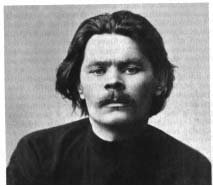
by Maksim Gorky
(1917)

It is a stuffy, summer night. A drunken woman, swing a bawdy tune, is dancing in a puddle that reaches up to her knees. A passing stranger--a 21-year-old man named Leonid--afraid that the woman will fall in the water and drown, pulls her out of the puddle. The woman, however, angrily shoves the stranger away and hurries back into the water, screaming for help. The night guard shows up and recognizes the woman as Masha, a local resident. She has a crippled son and raises up a scandal practically every night. Leonid suggests that they should take her home. The guard tells the stranger to do it if he wants to, but advises him to take a look at Masha's face first. The guard walks away.

Leonid again pulls Masha out of the water, and this time he sees that her face is scarred and disfigured. Leonid takes Masha to her grungy basement apartment. As they enter, Masha's 12-year-old son--also named Leonid, Lyonka for short--lights a lamp. Masha immediately flops down on the bed and falls asleep. Leonid takes off her wet dress and puts it on the stove. Lyonka asks Leonid if he's going to stay and lie down with Masha...everyone does, he says.

Leonid declines the offer, and sits to talk with the boy with withered legs. The boy happily shows off his menagerie: boxes containing flies, cockroaches, and other bugs, all of which he has named and ascribed various characteristics to. There's a cockroach named Anisim, a boaster like a soldier; a fly named Bureaucrat, a real scum; another cockroach called Landlord, nothing but a shameless drunkard. Unfortunately, there are no moths or butterflies in the collection.

With a heart-warming smile, Lyonka says that his mother is really a great person--just a drunkard.

Lyonka thinks that Leonid looks like a thief--but he's really just a kvas salesman. Leonid is so charmed with the boy that he promises to come visit again. The boy asks Leonid to bring some kvas and some boxes for his bugs.

After returning home, Leonid goes to a store and buys some nice, clean boxes. He asks the boys in his neighborhood to catch bugs and butterflies for him. He then returns to Lyonka's, bringing the bugs, boxes, cookies, and buns. Lyonka is thrilled with the gifts and even wants to wash his hands before touching the nice new boxes. Masha obviously dotes on the boy. Lyonka tells her that one of the new bugs looks like a monk who once hired her to make a rope ladder for him--so that he could climb into the windows of his lady friends late at night. Lyonka tells Masha to put on the samovar. Leonid gives her money to go buy sugar. On her way out, Lyonka asks Masha to clean his basement window so that he can see the world outside.

After she leaves, Lyonka starts singing one of many bawdy songs he has learned from his mother. He stops, however, when he hears an organ grinder playing outside. He asks Leonid to hold him up to the window so he can look out the window. Leonid does this. Lyonka watches and listens to the music, enrapt, until some neighbors chase away the organ grinder.

Lyonka then tells Leonid about some nightmares he's had. Once he dreamt of a tree growing upside-down; and once of a dog who kept eating his mother's intestines and spitting them out. Nonetheless, the boy says, he doesn't fear these nightmares.

He ate one of the candies Leonid brought, then carefully smoothed and saved the paper. He'll use it to make something nice for Katka, the water-delivery girl, his only friend. Katka likes nice things like pieces of glass, bits of pottery and paper.

Lyonka then asks, if he feeds a cockroach enough will it grow as big as a horse? Seeing that the boy believes this, Leonid says yes. Lyonka is happy and says his mother only laughs at this idea. He dreams of raising flies as big as dogs and cockroaches as big as horses. Such cockroaches could be used to haul bricks, their antennae serving as a type of reins. Lyonka could then sell such giant cockroaches and use the money to buy his mother a house in an open field.

The boy asks Leonid if he's ever been in an open field, then listens excitedly as Leonid describes fields and meadows. He says that he would like to see an open field, and if he ever went there, he would take his menagerie of bugs and let them go in the field.

Masha returns with sugar and...vodka. Lyonka says he only gets mad at his mother when she doesn't clean his window. Tea is served. Lyonka says that when he gets bigger, his mother will build him a cart and he will go about town begging. And he will go see an open field. His mother laughs, saying that Lyonka imagines an open field as a paradise, but, she reminds him, there he will find prison camps, trouble-making soldiers, and drunken muzhiks. They argue about this like children for a bit.

Lyonka grows tired but doesn't want to sleep, fearing that Leonid will leave. Masha promises that she'll make him stay. Before drifting off to sleep, Lyonka tells Masha that she should marry Leonid...he's good, not like the others who only beat her.

As the boy sleeps, Masha tells Leonid that Lyonka is her only comfort in life and that she is so proud of him. His father was an old notary for whom Masha worked as a maid.

Masha thanks Leonid for making the day a holiday for Lyonka. She puts her hand on his knee and tenderly says she'd like to repay him. Leonid declines the offer, but Masha says she'll cover her face if he wants. Just then, Lyonka mumbles in his sleep. Masha lovingly goes over to the boy. Leonid leaves, and as he passes the basement window, he hears Masha singing to her son a strange lullabye:

Fat-Faced Passions are coming
They bring with themselves Disasters
They bring Disasters
They'll tear your heart in pieces!
Oh, misfortune. Oh, misfortune.
Where shall we hide, where?

Leonid hurries away, gritting his teeth so as not to howl in anguish.

THE END

gorky3
Biography of Maksim Gorky

Maksim, Gorky. Pen-name of Aleksei Maksimovich Peshkov, born 28 March (16 March, Old Style) 1868 in Nizhny Novgorod, a city later to be renamed Gorky in his honor.

Early in his life, Gorky's family moved to Astrakhan, where he father worked as a shipping agent. His father died when the young Gorky was only five years old, and he was sent to live with his grandparents. At the age of eight, he quit school and was apprenticed to various tradesmen... (...Continued...)

mainbut2
One- and two-sentence summaries of over 200 works. biosbut linksbut textsbut bonusbut newbut
Address all correspondence to: ComradeChairman@SovLit.com

Subscribe to the
SovLit.com Mailing List.
Send e-mail with the word
SUBSCRIBE
in subject field to:
sovlit-subscribe@yahoogroups.com

2001 SovLit.com All rights reserved. May not be copied or reproduced in whole or part without express permission of SovLit.com