
The Wayback Machine - http://www.sovlit.com:80/chess.html
facetiny bigdot3


Works of Soviet Literature summarized for those unable or too lazy to read them in the original.

chair6

INTERPLANETARY CHESS CONGRESS

From "The 12 Chairs"
by Ilya Ilf & Evgeny Petrov
1929
(Translated by Eric Konkol)
[Con man Ostap Bender and his unfortunate companion, Ippolit Matveevich Vorobianinov (a.k.a. K. Michelson, a.k.a. Kisa) find themselves stranded, hungry, and broke in the insignificant, backwater town of Vasiuki on the Volga River]

That morning, wearing a green pince-nez and small, dirty shoes spattered with paint, the tall, thin Ippolit Matveevich Vorobianinov walked along the streets of Vasiuki. He was pasting hand-painted posters on walls and fences:

JULY 22, 1927
The Cardboard Factory Club
Announces
a lecture on the topic:
"FRUITFUL OPENING IDEAS"

AND

A PERFORMANCE OF SIMULTANEOUS
CHESS GAMES
ON 160 BOARDS


Grandmaster (senior master) O. Bender

Players must provide their own chessboards
Price for playing a game: 50 kopecks
Price for entrance: 20 kopecks

Begins at exactly 6 o'clock P.M.
Administration: K. Michelson.

Bender himself wasn't losing any time. Renting the meeting hall for 3 rubles, he hurried over to the local chess club, which, for some reason, was located in a corridor of the administration building of a stud farm.

At the chess club sat a one-eyed man, reading an old novel.

"Grandmaster O. Bender!" Ostap declared, taking a seat at the table. "I'm arranging a performance of simultaneous games."

"Just a moment, comrade grandmaster!" the one-eyed man shouted. "Sit down, please. I'll be right with you."

horse5 And the one-eyed man ran out. Ostap looked over the chess club office. Hanging on the walls were photographs of racehorses, and on the table was a dusty ledger book with the title "Achievements of the Vasiuki Chess Club in 1925".
The one-eyed man returned with a dozen citizens of various ages. They formed a line and, one by one, stepped up to greet the grandmaster, announcing their names and respectfully shaking his hand.

"I'm on my way to Kazan," Ostap said curtly. "And I'm having a simultaneous exhibition this evening. You should come. But right now, if you'll excuse me, I'm not really in shape for a game. I'm exhausted after the Carlsbad tournament."

The Vasiuki chess enthusiasts gazed at Ostap with childlike admiration. Ostap couldn't stop himself. He felt a rush of new strength and chess ideas.

"You won't believe," he said, "how far chess thought has progressed. You know, Lasker's using vulgar tactics. It's impossible to play with him. He blows cigar smoke on his opponents. And he purposely smokes cheap cigars so the smoke is more disgusting. The chess world is in an uproar."

The grandmaster moved on to local topics.

"Why, in the provinces, is there no chess thought? For example, your club. What's it called? `Chess club'. It's boring, girls! Why don't you name it something beautiful, something in the spirit of chess? The nation's masses would beat a path to your club's door. For example, you could name it "Four Knights Club", "Beautiful Endgame", or "Loss of Material Compensated for by Gain of Tempo". That would be good! Sweet sounding!"

The idea was successful.

"Really", the locals said, "why not rename our club the `Four Knights Club'?"

Since the executive committee of the chess club was right there, Ostap organized, under his honorary chairmanship, a minute-long meeting at which the club was unanimously renamed "Four Knights Chess Club". The grandmaster, with his own hand, artistically executed on a piece of cardboard a design with four knights and an accompanying inscription.

This important measure augured a dawn of chess thought in Vasiuki.

"Chess!" Ostap said. "Do you know what chess is? It advances not only culture, but the economy, too! Do you know that your Four Knights Chess Club, under the right circumstances, could completely transform the city of Vasiuki?"

Ostap had eaten nothing since yesterday. Therefore, the elegance of his speech was extraordinary.

"Yes!" he shouted. "Chess enriches the nation! If you agree to my proposal, you'll have a marble staircase descending from the city to the pier! Vasiuki will become the center of ten provinces! What had you previously heard about the town of Zimmering? Nothing! But now, this little burg is rich and famous only because it hosted an international tournament. Therefore, I say: we must organize an international chess tournament in Vasiuki."

"How?" everyone shouted.

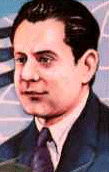
"It's a completely realistic idea," answered the grandmaster. "My personal connections and your initiative are all that's needed to ensure the organization of the international Vasiuki tournament. Think how beautiful it will sound: "The International Vasiuki Tournament for 1927". The attendance of Jose Raul Capablanca, Emanuel Lasker, Alekhine, Nimtzovitz, Reti, Rubenstein, Marotsi, Tarrasch, Widmar, and Doctor Grigoriev is assured. Moreover, my participation is assured."

"But, money," the locals groaned. "You have to pay all of them money. Thousands of rubles. Where can we get it?"

"Everything will be taken care of, like in a great hurricane," said O. Bender. "We'll take up a collection."

"Who in Vasiuki is gonna give you such insane amounts of money?"

"What do you mean Vasiuki? The people of Vasiuki won't give any money. They will collect the money. It's really very simple. A tournament with the participation of such world-class masters is sure to attract chess lovers from around the world. Hundreds of thousands of people--wealthy people--will rush to Vasiuki. In the first place, river transport will not be able to carry such a large number of passengers. Therefore, the Transportation Ministry will build a railroad line between Moscow and Vasiuki. That's number one. Two: hotels and skyscrapers to house all these guests. Three: improvement of agriculture in a 1,000- kilometer radius. The guests will have to be provided with vegetables, fruits, caviar, chocolates. The palace in which the tournament will be played, that's number four. Five: construction of garages for the guests' cars. In order to broadcast the results of such a sensational tournament, they'll have to build a superpowerful radio station--that's number six. Now, concerning the Moscow-Vasiuki railroad line. Undoubtedly, such a line will not have the capacity to convey to Vasiuki all those desiring to come. From this will result the "Greater Vasiuki" airport--regular flights of airplanes and dirigibles to all corners of the world, including Los Angeles and Melbourne."

Dazzling prospectives opened up in front of the Vasiuki amateurs.

The size of the room widened. The rotten walls of the stud farm building fell away, and in its place arose a glass, 33-story palace of chess thought, towering into the blue sky. In each of its halls, in every room, even in the elevators, speeding by like bullets, people, deep in thought, sat playing chess on instructional gameboards made of malachite.

Marble staircases descended to the blue Volga. Ocean liners sat on the river. Cable cars carried up into the city fat-faced foreigners, chess ladies, Australian adherents of the Indian Defense, Indians in white turbans, supporters of the Ruy Lopez game, Germans, Frenchmen, New Zealanders, inhabitants of the Amazon River basin, and--envying the Vasiukites--people from Moscow, Leningrad, Kiev, Siberia, and Odessa.

An endless stream of cars flowed past the marble hotels. And then, everything stopped. From the fashionable hotel "Passed Pawn" emerged the world champion, Jose Raul Capablanca. Women surrounded him. A policeman dressed in a special chess uniform (checked riding breeches and bishops on the lapels) politely saluted. With great dignity, the one-eyed chairman of the Vasiuki "Four Knights Club" stepped up to the world champion.

capa5
"Jose Raul
Capablanca
frowned."
The conversation of these two luminaries, conducted in English, was interrupted by the arrival of a plane bearing Dr. Grigoriev and the future world champion, Alekhine.

Shouts of greeting shook the city. Jose Raul Capablanca frowned. The one-eyed one, with a wave of his hand, caused a marble staircase to be rolled up to the airplane. Dr. Grigoriev ran down the steps, waving his new hat in greeting and commenting on a possible error by Capablanca in his upcoming match with Alekhine.

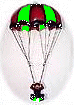
chute2 Suddenly, on the horizon appeared a black dot. It quickly approached and grew in size, turning into a large, emerald-green parachute. Like a large radish, a man with a suitcase was dangling from the parachute.

"It's him!" shouted the one-eyed one. "Hoorah! Hoorah! Hoorah! I recognize the great chess philosopher Lasker. He's the only one in the whole world who wears such green socks."

Jose Raul Capablanca again frowned.

The marble staircase was quickly put under Lasker and the bold ex-champion, blowing away some dust which had settled on his left sleeve during his flight over Silesia, fell into the embrace of the one-eyed one. The one-eyed one took Lasker by the waist, lead him up to the champion, and said:

"Make peace with one another! I beg you, in the name of the great Vasiuki masses! Make peace!"

Jose Raul audibly sighed and, shaking the hand of the old veteran, said:

"I have always admired your idea in the Ruy Lopez game of moving the bishop from b5 to c4."

"Hoorah!" exclaimed the one-eyed one. "Simple and decisive, in the style of a champion!"

The large, unimaginable crowd took up the cheer.

"Hoorah! Vivat! Banzai! Simple and decisive, in the style of a champion!!!"

Express trains rolled up to the 12 Vasiuki train stations, disgorging more and more crowds of chess lovers.

The sky was starting to blaze with flashing advertisements when a white horse was led along the streets of the city. This was the only horse remaining after the mechanization of Vasiuki's transport. By special declaration it was renamed a knight, even though for its whole life it had been called a filly. Chess worshippers greeted the horse, waving palm branches and chess boards.

"Don't worry," said Ostap, "my plan guarantees your city an unheard of blossoming of industrial strength. Think of what it will be like when the tournament is over and all the guests leave. The residents of Moscow, squeezed by the housing crisis, will rush to your excellent town. The capital will automatically be transferred to Vasiuki. The government will come here. Vasiuki will be renamed New Moscow, and Moscow will be renamed Old Vasiuki. People from Leningrad and Kharkov will grind their teeth, but there's nothing they can do about it. New Moscow will become the most elegant center of Europe, and soon, of the entire world."

"Of the entire world!!!" the stunned Vasiukites started to stammer.

"Yes! And then, of the universe. Chess thought, turning a provincial town into the capital of the planet, shall turn into applied science and create the methods of interplanetary communication. From Vasiuki signals will be sent to Mars, Jupiter, and Neptune. Communication with Venus will become as simple as a trip from Rybinsk to Yaroslav. And then, who knows, maybe, after eight years, Vasiuki will host the first-in-the- history-of-the-universe interplanetary chess congress!"

Ostap wiped his noble brow. He was so hungry, he would gladly have eaten a roasted chess horse.

"Yes-s-s," the one-eyed one allowed himself to say, taking in the dusty room with a frantic glance. "But how can we take practical measures to bring this about, to lay the base, as it were?"

The audience intently gazed at the grandmaster.

"I repeat that practically everything depends on your initiative. All of the organization, I repeat, I will undertake myself. There's no material expenditure, except the cost of telegrams."

The one-eyed one nudged his comrades-in-arms.

"Well," he asked. "What do you say?"

"We'll do it! We'll do it!" shouted the locals.

"How much money do you need for...telegrams?"

"A laughable sum," Ostap said. "A hundred rubles."

"We've only got 21 rubles and 16 kopecks in the till. This, of course you understand, is far from sufficient...."

But the grandmaster turned out to be an obliging organizer.

"Okay," he said. "Give me your 20 rubles."

"Will that be enough?" asked the one-eyed one.

"For the initial telegrams it will be enough. Then the contributions will start pouring in, and we won't have enough places to put the money."

Putting the money away into his green jacket, the grandmaster reminded the gathering of his lecture and demonstration of simultaneous games on 160 boards, amiably bid farewell until the evening, and set off for the Cardboard Factory Club to meet Ippolit Matveevich.

****

"I'm starving", said Vorobianinov with a cracking voice.

He was already sitting behind the ticket window, but he had not taken in a single kopeck and couldn't even buy any bread. In front of him sat a green wire basket, intended for the receipts. In such baskets, people in middle-class homes store knives and forks.

"Listen, Vorobianinov", Ostap shouted, "close the ticket window for an hour and a half! Let's go eat and drink. I'll describe the situation to you on the way. Incidentally, you need to shave and get cleaned up. You look like a tramp. A grandmaster can't have such suspicious acquaintances."

"I haven't sold a single ticket", Ippolit Matveevich declared.

"No problem. By this evening they'll come running. The city has already contributed 20 rubles to me for organizing an international chess tournament."

"Then why do we have to go on with the demonstration of simultaneous games?" whispered the administrator. "They could kill us. And with the 20 rubles we could buy passage on a steamer out of here. The "Karl Libknekht" just docked. We could quietly sail down to Stalingrad."

"It's impossible to say such stupid things on an empty stomach. It has a harmful effect on the brain. For 20 rubles we might be able to get to Stalingrad. But what are we gonna buy food with? Vitamins, my dear comrade district leader of the nobility, aren't given away for free. However, from the expansive locals, we might be able to get 30 rubles for the lecture and simultaneous games."

"They'll kill us!" Vorobianinov bitterly said.

"Of course there is a risk. We could get our faces smashed. However, I have one little idea which, in any case, should reassure you. But I'll tell you about it later. It's time to go sample the local cuisine."

A little before 6 o'clock that evening, well-fed, shaved, and smelling of eau de cologne, the grandmaster stepped into the ticket booth at the Cardboard Factory Club.

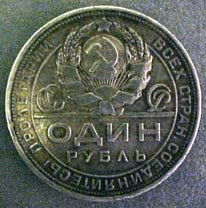
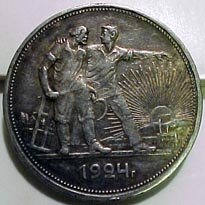
One Ruble - 1924
ruscoin1
ruscoin2
Sated and shaved, Vorobianinov was busily selling tickets.

"Well?" the grandmaster quietly asked.

"Thirty entrance tickets and 20 tickets to play against you," the administrator replied.

"That's 16 rubles. Too little, too little."

"Bender, look at the line of people standing here! They'll kill us for sure."

"Don't even think about it. When they kill us, then you can cry. Until then, control yourself! Attend to business!"

An hour later, there were 35 rubles in the ticket office. The public in the hall was getting restless.

"Close the window! Give me the money!" said Ostap. "Now here's what we'll do. Here's five rubles for you. Go down to the pier, rent a boat for two hours, and wait for me on the shore just below the warehouse. We'll take an evening outing. Don't worry about me. I'm in good form today."

The grandmaster stepped into the hall. He felt invigorated and firmly knew that his first move, e2-e4, presented him with no complications. The rest of the moves, it is true, were enshrouded in a fog, but that in no way disturbed the great artful dodger. He had prepared a completely unexpected way of escape from even the most hopeless game.

The grandmaster was met with applause. The small club hall was decorated with little flags of various colors.

A week ago there had been a meeting of the "Water Rescue Society", which was attested to by a slogan hanging on the wall:

THE TASK OF AIDING THE DROWNING
IS THE RESPONSIBILITY OF THE DROWNING THEMSELVES

Ostap bowed, stretched his hands out forward as if dismissing undeserved applause, and stepped out onto the stage.

"Comrades!" he said in a fine voice. "Comrades and brothers in chess, the subject of my lecture today will be something I read about--and, I must confess, not without success--in Nizhni- Novgorod last week. The topic of my lecture is `A Fruitful Opening Idea'. What, comrades, is an opening and what, comrades, is an idea? The opening, comrades, is Quasi una fantasia. And what, comrades, does an idea mean? An idea, comrades, is human thought, expressed in logical chess form. Even with insignificant forces, it's possible to control the entire board. It all depends on each individual taken separately. For example, take that blond man in the third row. Let's suppose that he plays well...."

The blond man in the third row blushed.

"And that brown-haired man over there, let's say he plays worse."

Everyone turned around and looked at the brown-haired man.

"What do we see, comrades? We see that the blond-haired man plays well and that the brown-haired man plays poorly. And no lecture will ever change this balance of power if each individual, taken separately, does not constantly practice checkers...that is, I mean to say...chess. And now, comrades, I will relate to you a few instructive stories from the practice of our respected hypermodernists Capablanca, Lasker, and Dr. Grigoriev."

Ostap told the auditorium a few antiquated anecdotes gleaned in his youth from the "Blue Journal" and then concluded with an interlude.

Everyone was somewhat surprised by the brevity of the lecture. And the one-eyed one did not take his single eye off the grandmaster's footwear.

However, the beginning of the exhibition of simultaneous games restrained the one-eyed chess player's growing suspicion. Along with everyone else, he set up the tables quietly. In total, 30 amateurs sat ready to play against the grandmaster. Many of them were complete nervous wrecks and kept glancing into chess textbooks, refreshing their memories about complicated variations with the aid of which they hoped to resign to the grandmaster, although after 22 moves.

Ostap slid his gaze along the ranks of the "blacks" who surrounded him on all sides, glanced at the closed door, and fearlessly set about his work. He stepped up to the one-eyed one, who was sitting at the first gameboard, and moved his king's pawn from square e2 to square e4.

"The grandmaster moved e2-e4!"

Ostap did not indulge his opponents with varied openings. On the remaining 29 boards he undertook exactly the same operation: he moved his king's pawn from e2 to e4. One after another, the amateurs started pulling out their hair and plunged themselves into feverish contemplation. The spectators followed the grandmaster closely with their eyes. The only amateur photographer in the city was already clambering up onto a chair and getting ready to set off the flash, but Ostap angrily waved his hands and, interrupting his movement along the boards, angrily shouted:

ruy2
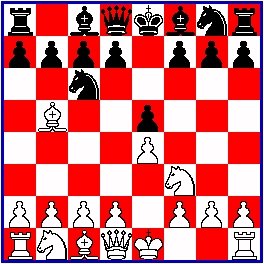
The Ruy Lopez
1.e4 e5 2.Nf3 Nf6 3.Bb5
"Get rid of the photographer! He's disturbing my chess thought!"

"Why should I leave my photograph in this pitiful village. I have no desire to get involved in police matters," he thought to himself.

The indignant hissing of the chess lovers forced the photographer to abandon his attempt. The uproar was so great that they even shoved the photographer out of the premises.

By the third move it became clear that the grandmaster was playing 18 Ruy Lopez games. In the remaining 12 games, black undertook the somewhat old but sufficiently dependable Philador Defense. If Ostap knew that he was playing such an intelligent opening and contending with such a well-tried defense, he would have been very much surprised. The fact is that the artful dodger was playing chess for the second time in his life.

At first, the amateurs--and first among them was the one-eyed one--were horror-struck. The craftiness of the grandmaster was undoubted.

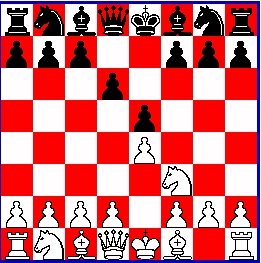
phil
Philador's Defense
1.e4 e5 2.Nf3 d6
With incredible ease and, no doubt, laughing maliciously to himself at the residents of Vasiuki, the grandmaster sacrificed pawns as well as major and minor pieces left and right. To the brown-haired man whom he ridiculed at the lecture he even sacrificed his queen. The brown-haired man was terrified and wanted to resign immediately, but he made a great effort of will and forced himself to continue the game.

After five minutes, thunder unexpectedly struck.

"Mate," murmured the brown-haired man, who was deathly afraid. "I have mated you, comrade grandmaster."

Ostap analyzed the position, disgracefully called the queen the "king's wife", and bombastically congratulated the brown-haired man on the win. A rumble moved through the rows of amateurs.

"It's time to get out of here," thought Ostap, pacing among the tables and carelessly moving pieces.

"You didn't mo your knight correctly, comrade grandmaster," cringed the one-eyed one. "The knight doesn't move like that."

"Pardon, pardon, excuse me," answered the grandmaster. "I'm a little tired after the lecture."

In the course of the next ten minutes, the grandmaster lost another ten games.

"The `Bender Rook Capture' is a genuis maneuver. Simple and elegant. I use it whenever I can."
Anatoly Fisharov
Imaginary Chess Champion
Surprised cries resounded in the room of the Cardboard Factory Club. The conflict was coming to a head. Ostap lost 15 games in a row, then another three. There remained only the one-eyed one. At the beginning of the game, one-eye had made numerous errors out of fear, but now, with effort, he had brought the game to a winning position. Ostap, unseen by the crowd, stole the black rook off the board and hid it in his pocket.

The crowd pressed close around the players.

"My rook was standing right here!" shouted the one-eyed one. "Look! And now it's gone!"

"Well, that means it wasn't there," Ostap answered crudely.

"How could it not be there? I remember distinctly!"

"Of course it wasn't there!"

"Where did it go? Did you capture it?"

"I captured it."

"When? On what move?"

"Why are you trying to distract me with this rook? Resign, and then you can talk to me."

"Excuse me, comrade, I have all the moves written down here!"

"Bureaucratic nonsense," said Ostap.

"This is scandalous!" the one-eyed one began yelling. "Give me back my rook!"

"Resign, resign! Stop this cat-and-mouse game!"

"Give me back my rook!"

With these words, the grandmaster, understanding that death was knocking at the door, scooped up a handful of pieces and flung them at the head of his one-eyed opponent.

"Comrades!" squealed the one-eyed one. "Everyone, look! He's assaulting the amateurs!"

The chess players of Vasiuki were stunned.

Not losing any valuable time, Ostap flung the chessboard at the lamp and, in the ensuing darkness, smashing a few jaws and foreheads, dashed out onto the street. The Vasiuki amateurs, falling over one another, took off after him.

It was a moonlit night. Ostap darted along the silver street like an angel, leaving behind the sinful earth. In view of the unrealized transformation of Vasiuki into the center of the universe, Ostap had to run, not past palaces, but past wooden huts with shutters.

Behind him rushed the chess amateurs.

"Get the grandmaster!" roared the one-eyed one.

"Scoundrel!" the rest shouted in support.

"Twits!" snapped back the grandmaster, picking up speed.

"Police!" shouted the insulted chess players.

Ostap jumped down along the staircase leading to the pier. He had 400 more steps to go. On the sixth landing there were two amateurs already waiting for him. They had come by a short-cut along the slope. Ostap looked around. Bearing down on him from above, like a pack of dogs, came the thick crowd of enraged adherents of the Philador Defense. There was no retreat. Therefore, Ostap rushed forward.

"I'll get you now, you swine!" he yelped out at the warrior- scouts, leaping at them from the fifth landing. The frightened, dismounted Cossacks cried out, fell over the railings, and rolled off somewhere into the darkness over the knolls and slopes. Ostap's way was open.

"Get the grandmaster!" came rolling down from above.

The pursuers ran on, knocking against the wooden staircase like falling bowling balls.

Coming out onto the shore, Ostap darted to the left, looking for the boat with his trusty administrator.

Ippolit Matveevich was sitting idyllically in the boat. Ostap leapt onto the seat and feverishly started rowing away from the shore. After a minute, rocks started flying toward the boat. Ippolit Matveevich was hit by one of them. A dark, twitching knot of muscle arose just above the volcanolike pimple on his face. Ippolit Matveevich pulled his head down and started whimpering.

"What a wimp! They nearly ripped my head off, and I'm just fine. Bold and happy. And if you take into consideration the 50 rubles of pure profit, for one little scratch on your head, the royalties are decent enough."

Meanwhile, the pursuers, who only now understood that the plan for transforming Vasiuki into New Moscow had collapsed and that the grandmaster was leaving town with 50 of their hard-earned rubles, piled into a large boat and, shouting, rowed out to the center of the river. Thirty people were crowded in the boat. All of them wanted to take part personally in the rematch against the grandmaster. The expeditionary force was being commanded by the one-eyed one. His one eye shone in the night like a lighthouse beacon.

"Get the grandmaster!" they wailed in the overcrowded barge.

"Row, Kisa!" Ostap said. "If they catch up, I can't guarantee the safety of your pince-nez."

Both boats followed the current. The distance between them kept shrinking and shrinking. Ostap was rowing as hard as he could.

"You're not going anywhere, swine!" they shouted from the barge.

Ostap didn't answer. There was no time. The oars shot up out of the water. Streams of water flew up from under the raging oars and landed in the boat.

"Keep going," Ostap whispered to himself.

For more hijinks on
the Volga, read:

"The Volga Falls
To the Caspian Sea"

at
smalldot

Tell 'em Ostap sent you!
Ippolit Matveevich sniveled. The barge was celebrating. Its high hull was overtaking the concessionaires on the left side in order to force the grandmaster to the shore. A woeful fate awaited the concessionaires. The joy in the barge was so great that all the chess players moved to the starboard side so that, once they were even with the boat, they might rain down on the evil-doer/grandmaster with overpowering force.

"Hold onto your pince-nez, Kisa!" Ostap shouted out in despair, throwing away the oars. "Now it begins."

"Good Lord!" Ippolit Matveevich suddenly exclaimed like a rooster. "Are you really going to beat us?"

"And how!" the Vasiuki amateurs thundered, getting ready to jump into the boat.

But at that moment, something highly offensive to all honest chess players of the world occurred. The barge suddenly began to list and take in water on the starboard side.

"Careful!" squealed the one-eyed captain.

But it was too late. Too many chess amateurs had gathered on the starboard side of the Vasiuki dreadnought. Changing its center of gravity, the barge did not hesitate, but, in complete compliance with the laws of physics, overturned.

A joint yelp broke the tranquility of the river.

"Oo-ah-oo!" was the long, drawn-out groan of the chess players.

All thirty amateurs found themselves under the water. They quickly swam to the surface and, one after another, latched onto the overturned barge. The last to moor himself was the one-eyed one.

"Twits!" Ostap shouted in delight. "What, you're not going to beat your grandmaster? You, if I'm not mistaken, wanted to beat me?"

Ostap made a circle around the disaster victims.

"You understand, my Vasiuki individuals, that I could drown you one by one. But I give you your lives. Live, citizens! Only, please God, don't play chess! You simply don't know how to play! You twits, twits....Let's go, Ippolit Matveevich. Good-bye, you one-eyed amateurs! I'm afraid that Vasiuki will not become the center of the universe. I don't think any chess masters would come to such fools like you even if I were to ask them. Good- bye, lovers of great chess sensations! Long live the `Four Knights Club'!"

THE END

ilfipetrov2
Biography of Ilya Ilf & Evgeny Petrov

Ilf, Ilya and Petrov, Evgeny. Pseudonyms of Ilya Arnoldovich Fainzilberg and Evgeny Petrovich Kataev, respectively. Ilf was born on 15 October 1897 and Petrov on 13 December 1903, both in Odessa. Petrov's older brother was the writer Valentin Kataev. Ilf began his career as a journalist at age 18. Petrov, the son of a teacher, also began as a news correspondent, although he worked briefly as a criminal investigator.

Ilf and Petrov, independent of one another, arrived in Moscow in 1923. Ilf went to work for the magazine Gudok. . . (...Continued...)


mainbut2
artlitbut spybut scifibut humorbut kidsbut
One- and two-sentence summaries of over 100 works. biosbut linksbut helpbut
Address all correspondence to Comrade Chairman at: ComradeChairman@sovlit.com

Subscribe to the
SovLit.com Mailing List.
Send e-mail with the word
SUBSCRIBE
in subject field to:
sovlit-subscribe@egroups.com

2000 SovLit.com All rights reserved. May not be copied or reproduced in whole or part without express permission of SovLit.com