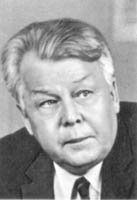
 Tvardovsky, Aleksandr Trifonovich. Born 21 June 1910
in the village of Zagorye, Smolensk district. His father was a literate
blacksmith who scraped together enough money to buy a small plot of
swampy land, which the family proudly worked.
Tvardovsky, Aleksandr Trifonovich. Born 21 June 1910
in the village of Zagorye, Smolensk district. His father was a literate
blacksmith who scraped together enough money to buy a small plot of
swampy land, which the family proudly worked.
As a youth, Travdovsky was active in his village Komsomol. In
1924 he began sending off to local newspapers poems about Komsomol
activities and various local abuses. His first publication came in 1925
when the paper "Smolensk Village" printed the poem New Hut
("Novaya Izba"). Three years later, when he was 18, Tvardovsky
gathered up all his poetry and went to Smolensk to visit the poet Mikhail Isakovsky.
This first meeting was the start of a life-long friendship.
Tvardovsky had only the incomplete education which a village school
could offer. He and other young poets in Smolensk at that time were all
in the same boat. As Tvardovsky later wrote:
Superficial reading and some small knowledge about the "little secrets" of the trade inspired in us dangerous illusions.
These illusions led the poet to undertake a trip to Moscow. A few of his works appeared in the journal October,
but he had difficulty finding work. So Tvardovsky returned to Smolensk
in the winter of 1930 and entered the Pedogogical Institute, where he
became a star pupil.
During this time, collectivization was going on. Tvardovsky was
also working as a reporter and often visited kolkhozes, so he was aware
of the suffering. He also felt it personally, since his father was
deported as a kulak. Nonetheless, Tvardovsky firmly believed
that the changes were necessary. He achieved a success with the
printing in "Molodaya Gvardia" of his longer poem The Path to Socialism
("Put' k Sotsializmu"), about life on a kolkhoz. Despite the critical
approval the piece received at the time, Tvardovsky later criticized his
own work:
It was riding without holding the reins, loss of the rhythmic discipline of poetry; more simply stated, it wasn't poetry.
Tvardovsky considered his second major work, Vstupleniye
("Introduction") (1932), also to be a disappointment. Success and
national acclaim finally came to him in 1936 with publication of Strana Muraviya
("The Land of Muraviya"), the tale of a Don Quixote-like muzhik who,
not wanting to join the kolkhoz, wanders across the nation searching for
a kolkhozless area. He, of course, finds no such area and, in the end,
realizes that the only happy life is on the kolkhoz and returns home.
For this work, Tvardovsky was awarded his first Stalin Prize in 1941.
In 1936, Tvardovsky again moves to Moscow--this time as a recognized
poet--and enrolls in the Moscow Institute of History, Philosophy, and
Literature. In 1939, he graduates and publishes a collection of lyric
poems, Selskaya Khonika ("Village Chronicle"). He is also
called up into the army. He participates in the Red Army advance into
western Belorussia, in the Finnish War, and, of course, the Great
Patriotic War. It was during the Finnish War that Tvardovsky, writing
for the paper Na Strazhe Rodiny, created the character of
Vasya Tyorkin for a humor column. The peasant-soldier was very popular
with the real soldiers reading the paper, and he eventually was reworked
into the hero of Vassily Tyorkin. Of the poem, Tvardovsky said:
It was my lyric, my social commentary, song and sermon, anecdote and
embellishment, heartfelt conversation, and reaction to events.
"Vassily Tyorkin" received popular acclaim, essentially becoming a folk hero. This work won Tvardovsky his second Stalin Prize in 1946. Surprisingly, praise for this work also came from the staunch anti-Communist Ivan Bunin, who said:
This book is truly unique. What freedom of expression, what accuracy
and precision in every detail, what a wonderful soldiers' language--not a
hitch, not a single false or vulgar word.
The sadness and sorrow of war is expressed in Tvardovsky's 1946 poem Dom u Dorogi ("House by the Road"), which describes life in Russia under Nazi occupation. For this, Tvardovsky won yet another Stalin Prize in 1947. In 1946 he also composed a requiem for the fallen heros, Ya Ubit Podo Rzhevom.
In 1961 he won a Lenin Prize for Za Daliu--Dal'
("Distance Beyond Distance"), a contemplative work presented as a
journey across Siberia. In it, the narrator meets a friend returning
from a labor camp. Stalinism is condemned as a deviation from Leninism.
In 1954 Tvardovsky began work on Tyorkin Na Tom Svete
("Tyorkin in the Other World"), a type of parody-continuation of the
original Tyorkin tale, in which the hero visits hell and finds there a
distorted view of Soviet life. The work was not completed until 1963.
It was published, but not viewed favorably by government and Party
officials.
In 1968 he finished Po Pravu Pamyati ("By Right of
Memory"), in part a confession of his own mistakes, and in part a
warning to future generations. It was not published until 1987. In the
later years of his life, Tvardovsky focused mainly on lyric poetry.
He was made chief editor of the literary journal Novy Mir
in 1950, but was removed from the post in 1954 following his publication
of "Sincerity in Literature" by Pomerantsev. However, he was
reinstated in 1958 and continued in the post until 1970. During that
time, he secured publication for Solzhenitsyn's "One Day In The Life of
Ivan Denisovich" and "Cancer Ward".
Tvardovsky was member of the Directorate of the Soviet Writers Union and
a candidate member of the Central Committee of the Communist Party of
the Soviet Union.
He died on 18 December 1971, following a long illness.
|